

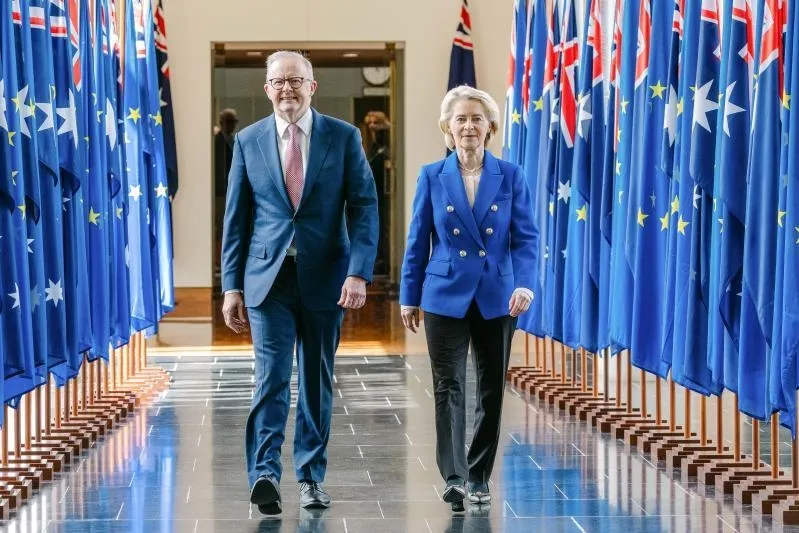
On 24 March, the European Union and Australia concluded negotiations on a comprehensive Free Trade Agreement (FTA), aimed at strengthening economic cooperation and reinforcing supply chain resilience.
The FTA is expected to open new opportunities for European businesses by removing over 99% of tariffs on EU exports to Australia and improving access to services and public procurement markets. The agreement also includes provisions facilitating data flows and reducing administrative barriers, supporting more efficient and predictable trade operations.
The FTA is particularly relevant for supply chains, as it strengthens cooperation on critical raw materials, contributing to improved resilience of EU value chains against external disruptions. In addition, the agreement reflects the growing importance of digitalisation in logistics and trade, with measures supporting interoperable systems and more efficient customs and administrative processes. This is expected to benefit transport and logistics operators by reducing complexity and improving transparency in cross-border operations.
With the conclusion of negotiations for an ambitious and balanced free trade agreement (FTA), the EU is opening the market to one of the world's fastest-growing developed economies and thereby bringing significant economic opportunities to European companies, consumers and farmers.
EU exports are expected to grow by up to 33% over the next decade, with export value reaching up to €17.7 billion annually. Key sectors with strong growth potential include dairy (expected to increase by up to 48%) motor vehicles (52%), and chemicals (20%). EU investment into Australia has the potential to grow by over 87%.
With this deal the EU also reinforces its strategic interests in the area of critical raw materials, making EU supply chains stronger and more resilient against geopolitical shocks. The FTA also includes strong sustainability commitments, which will contribute to greener and fairer trade, and ensures that imports into the EU are more aligned with the EU's own production standards on climate, environmental and animal welfare.
Following recently concluded deals with Indonesia and India, this agreement further diversifies the EU's network of trade partners in the strategically important Indo-Pacific region and strengthens Europe's position on the global stage.
Maroš ŠefÄoviÄ, Commissioner for Trade and Economic Security; Interinstitutional Relations and Transparency said, "Our network of FTA partners continues to expand and the agreement between the EU and Australia could not come at a better time. It is timely, ambitious and strategically important. Ultimately, it is about creating business opportunities and supporting jobs. Our trade already sustains 460,000 European jobs – just imagine the potential, with EU goods exports expected to grow by 33% over the next decade. I look forward to seeing this agreement put into practice as soon as possible, for the shared benefit of all stakeholders."
Following the conclusion of the negotiations, the agreement will have to undergo legal finalisation and be ratified by both parties.
The Commission has also published a questions and answers document on the FTA, which can be accessed here.
This article courtesy of CLECAT with extracts from the European Commission.
Photo: Prime Minister of Australia Anthony Albanese and European Commission President Ursula von der Leyen
