

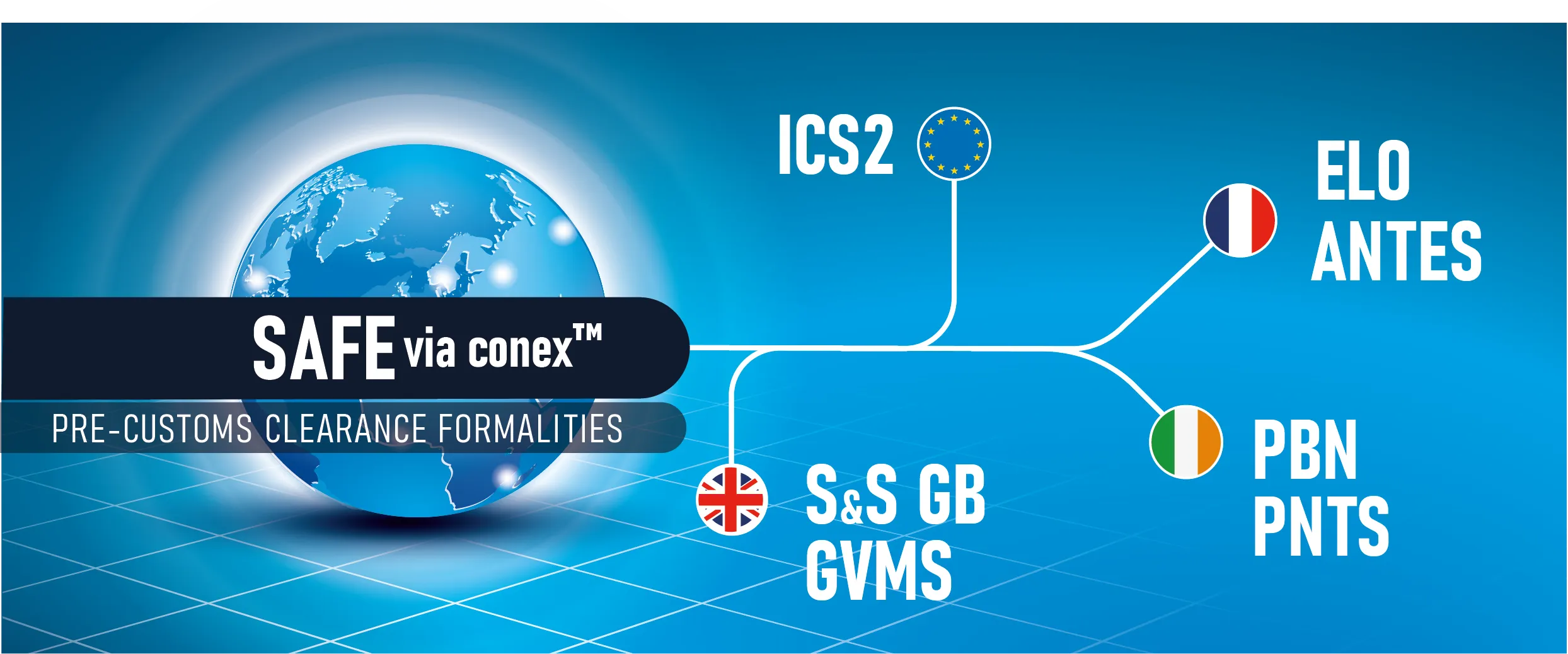
The roll-out of the EU safety and security advance filing requirement ICS2 has seemed never-ending but there is light at the end of the tunnel. Channel tunnel, of course. What started with PLACI (Pre-Loading Air Cargo Information) filings from express carriers and designated postal operators back in March 2021, had general air cargo and message combination complexity added in 2023, gradually brought maritime and inland waterway carriers and house-level filers on board during 2024. Finally, 2025 is the year for road and rail, but it’s not quite that simple.
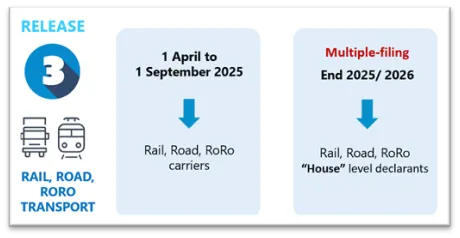
Like maritime transport, road and rail ICS2 filings will be introduced in two phases: complete “carrier” messages first, then combinations of master- and house-level filings implemented later.
For the first phase, the EU authorities have provided for a transitional period, called Deployment Window, from 1st April to 1st September this year. This means that goods brought into the EU by road or rail must be the subject of a pre-filed safety and security declaration by the end of August this year at the very latest. The Deployment Window mechanism requires that operators responsible for filing Entry Summary declarations (ENS) must have requested permission from the EU Member State from which their EU EORI was granted.
Let’s look first at who can file. Although the legal responsibility lies with the “carrier”, the real importance is who has the required data at the right time. The road haulier may wish to sub-contract the filing to a freight forwarder who has contracted the haulier for the transport. The EU considers that such arrangements are totally in the hands of the logistics chain operators. What is important is that the goods have been risk-analysed and that an MRN has been returned. Depending on where the goods enter the EU, the MRN will then either be required for submitting the new French ELO (Enveloppe Logistique Obligatoire or obligatory logistics envelope) for cross-Channel flows or the IE PBN (Pre-Boarding Notification) for flows to Ireland, both similar to the UK GMR.
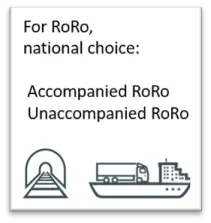
RoRo movements across the English Channel, Irish Sea or North Sea are not always considered in the same way. In many Member States accompanied RoRo, where the driver remains with the goods being transported, is considered as “Road” and unaccompanied or driverless flows are “Maritime” and each follows the rules and submission deadlines for the respective mode of transport. However, RoRo movements to The Netherlands, for example, are all treated as maritime flows and as such, the ferry company, as carrier, is responsible for filing the ENS.
There are also rules imposed by specific Member States about transport details themselves, especially concerning “active” and “passive” means of transport. An example is the rather striking IMO 1111111 reference to be used for ferries from the UK to France or Ireland.
Users of the SAFE via conex™ solution can be assured that all such specificities are not only catered for, but can be pre-set, enabling filers to always remain in compliance with the rules.
As mentioned earlier, operators such as freight forwarders possessing House-level data for Road and Rail ENS filings will have the opportunity to “self-file”, but not yet. Multiple filing is due to come into effect towards the end of 2025 or the beginning of 2026, once the European Commission has passed the corresponding rules into EU law. As Multiple filing for these modes of transport was not planned initially, it’s a case of playing legal catch up.
With the (very) gradual ICS2 roll-out nearing an end, operators already filing to the central EU ICS2 platform will have noticed a much stricter application of the rules recently. There have been reports of fines from certain Member States for filings that are submitted late. A recent European Commission publication called “Stop words” lists unacceptable descriptions of goods, parties and addresses that must NOT be used in ENS declarations. As some declarants have already experienced, the use of a “stop-word”-listed description is met by an error message and the requirement to refile the declaration.
From automatic data interface to its a user-friendly web application, SAFE via conex™ ensures its users of compliance for all cross-Channel pre-declarative formality needs, whatever your mode of transport and whatever your supply chain role.
To learn more and to stay informed of all the regulatory developments, be sure to contact CONEX.
CONTACT: paul.grobler@conex.net
This article courtesy of CONEX, Affiliate Members of IIFA.
